
Assessment Quiz
Instructions: Provide a concise answer (2-3 sentences) for each of the following questions based on the provided source material.
- Describe the basic structure of the plasma membrane’s lipid bilayer, including the orientation of its phospholipid components.
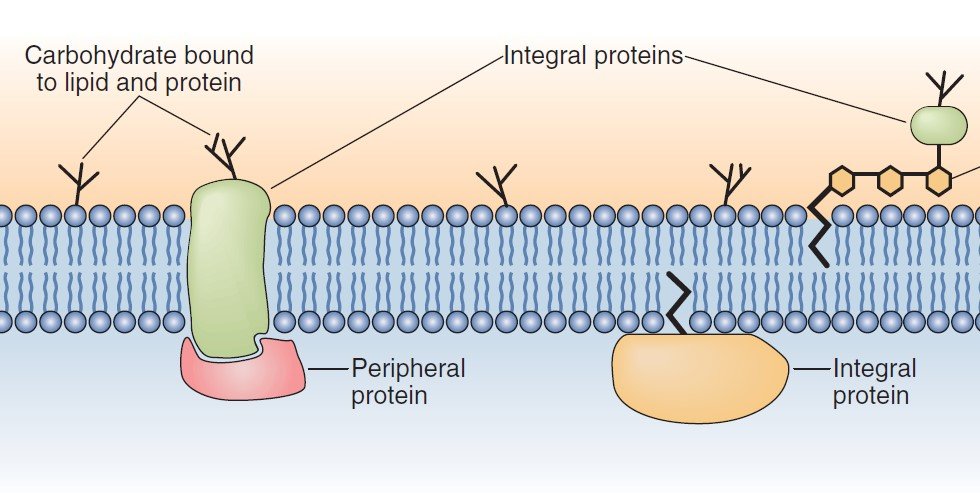
- Differentiate between integral and peripheral membrane proteins based on their location and method of attachment to the membrane.
- What is the glycocalyx, and what are two of its primary functions?
- Explain the key differences between simple diffusion and facilitated diffusion as forms of passive transport.
- Describe the mechanism of the Na⁺–K⁺ pump, including the direction of ion movement and its energy requirements.
- What are G protein-linked receptors, and what role do the subunits of a heterotrimeric G protein play in signal transduction?
- How does cholesterol influence the fluidity and structural integrity of the plasma membrane?
- Define the transport processes of uniport, symport, and antiport.
- Explain the respective roles of spectrin and ankyrin in maintaining the structure of a red blood cell.
- What are the three types of gated ion channels, and what specific stimulus does each type respond to?
Answer Key
- The lipid bilayer is composed of two leaflets, with an inner leaflet facing the cytoplasm and an outer leaflet facing the extracellular environment. It consists of amphipathic phospholipids, which have a polar (hydrophilic) head facing the membrane surface and two nonpolar (hydrophobic) fatty acyl tails projecting into the interior, where they face each other and are attached by weak noncovalent bonds.
- Integral proteins are dissolved in the lipid bilayer, and many are transmembrane proteins that span the entire membrane thickness. Peripheral proteins do not extend into the bilayer; they are located on the cytoplasmic aspect of the inner leaflet and bind to phospholipid polar groups or integral proteins via noncovalent interactions.
- The glycocalyx, or cell coat, is located on the outer surface of the plasmalemma and consists of oligosaccharide side chains linked to proteins and lipids, as well as proteoglycans. Its functions include protecting cells from injury, facilitating cell-cell recognition and interaction, and binding antigens and enzymes to the cell surface.
- Simple diffusion is the transport of small nonpolar molecules (like O₂) and small, uncharged polar molecules (like H₂O) directly across the membrane down a concentration gradient. Facilitated diffusion is a faster process that uses specific ion channels or carrier proteins to provide a pathway for ions and large polar molecules that would otherwise be unable to cross the membrane.
- The Na⁺–K⁺ pump is a form of active transport that involves the antiport movement of ions mediated by the carrier protein Na⁺–K⁺ ATPase. For every single molecule of ATP that is hydrolyzed, the pump moves three Na⁺ ions out of the cell and two K⁺ ions into the cell, helping to maintain constant cell volume.
- G protein-linked receptors are transmembrane proteins that, after binding a signaling molecule, interact with a G protein. In a heterotrimeric G protein, the binding causes either the α subunit to dissociate and interact with its target, or the α subunit and/or the βγ complex become activated to interact with their targets, leading to the activation of intracellular second messengers.
- Cholesterol is present in both leaflets of the plasma membrane and helps maintain its structural integrity. It decreases the fluidity of the lipid bilayer; an increase in the membrane’s cholesterol content makes it less fluid.
- These are membrane transport processes. Uniport is the transport of a single molecule, symport is the cotransport of two different molecules in the same direction, and antiport is the cotransport of two different molecules in the opposite direction.
- Spectrin is a long, flexible protein that forms tetramers, creating a scaffold for structural reinforcement in the red blood cell cytoskeleton. Ankyrin links these spectrin tetramers to band 3 proteins (transmembrane proteins), thus attaching the spectrin–actin complex to the plasmalemma.
- The three types are voltage-gated channels, which open when the potential difference across the membrane changes; mechanically gated channels, which open in response to a mechanical stimulus; and ligand-gated channels, which open in response to the binding of a signaling molecule or ion.