
Short-Answer Quiz
Answer each question in 2-3 sentences based on the provided source material.
- What is the medical definition of heatstroke (hyperthermia), and what core body temperature is typically used for its diagnosis?
- Explain how high humidity contributes to the risk of developing heatstroke.
- List three distinct changes in consciousness or mental state that can be symptoms of heatstroke.
- What are the two contrasting skin conditions (regarding moisture) that can be observed in a person suffering from heatstroke?
- Why are fever-reducing medications generally not effective in treating the high body temperature associated with heatstroke?
- Identify two specific groups of people who are at a higher risk for heatstroke and explain the physiological reason for their increased vulnerability.
- What is the primary difference between heat exhaustion (sıcaktan bunalma) and heatstroke in terms of body temperature?
- Describe the correct first-aid procedure for applying ice packs to a person suspected of having heatstroke.
- Why should alcoholic or caffeinated beverages be avoided for both prevention and first aid related to heatstroke?
- What are two key reasons why babies and young children are particularly susceptible to heatstroke?
Essay Questions
Construct a detailed essay-format response for each of the following prompts, drawing exclusively from the information in the source text.
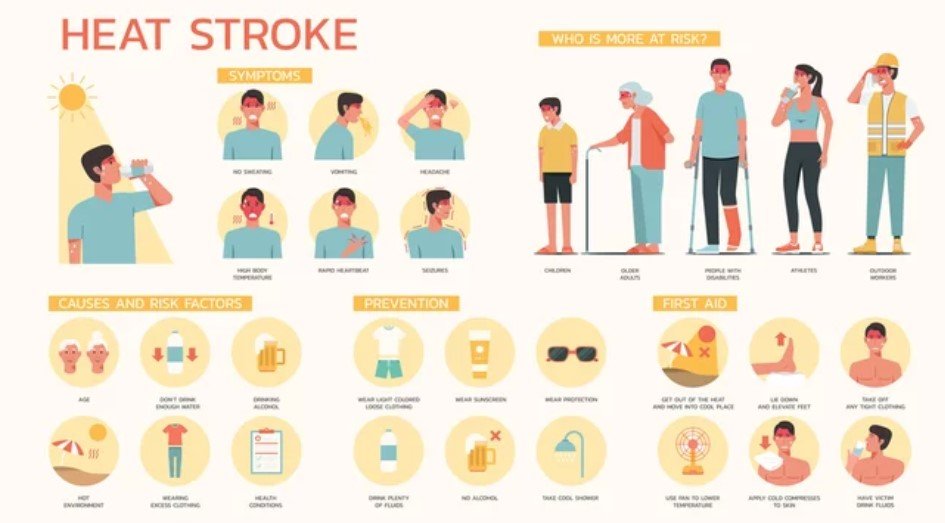
- Analyze the primary causes of heatstroke, detailing the interplay between environmental factors (like temperature and humidity), physiological responses (like sweating), and individual risk factors (like age, health conditions, and medication).
- Provide a comprehensive overview of the symptoms of heatstroke, categorizing them into physiological signs (e.g., body temperature, heart rate), neurological signs (e.g., consciousness, behavior), and other physical manifestations (e.g., skin changes, gastrointestinal issues).
- Formulate a detailed prevention plan for an individual who works outdoors in a hot climate, such as a construction worker. Your plan should address hydration, clothing, activity scheduling, and diet, as outlined in the source.
- Describe the complete sequence of actions for providing first aid to a person showing signs of heatstroke, from the initial response to the point of professional medical intervention. Explain the rationale behind each step, such as moving the person, removing clothing, and cooling methods.
- Compare and contrast the symptoms and risks of heatstroke in infants versus adults. Explain why the condition is more dangerous for babies and detail the specific first-aid steps recommended for a child exhibiting symptoms before medical help arrives.
Quiz Answer Key
- Heatstroke, also known as hyperthermia, is a life-threatening condition where excessive heat exposure causes the body’s temperature regulation system to fail. A diagnosis is typically made when the body’s temperature reaches 40°C (104°F) or higher.
- High humidity makes it difficult for sweat to evaporate from the skin’s surface. Since the evaporation of sweat is one of the body’s primary mechanisms for cooling itself, high humidity traps heat and causes body temperature to continue rising.
- Changes in mental state can include confusion, disorientation, agitation, and irritability. In more severe cases, a person may experience loss of coordination, hallucinations, or progress into a coma.
- In classic heatstroke, the skin is often hot, red, and dry, indicating the body’s sweating mechanism has failed completely. However, in heatstroke caused by intense physical activity, the person’s skin may still be sweaty and moist.
- Fever-reducing medications are not effective because the high body temperature in heatstroke is caused by excessive external heat and the body’s inability to cool itself, not by an infection-related fever process that these drugs are designed to target.
- The very young (babies/children) and the very old are at higher risk. Babies’ sweat glands are not fully developed, hindering their ability to cool down, while the elderly have smaller sweat glands, weaker circulatory systems, and a reduced sense of thirst, increasing their risk of dehydration.
- The primary difference is that in heat exhaustion, the body’s temperature is generally below 40°C. In heatstroke, the body temperature rises to 40°C (104°F) or higher, indicating a complete failure of the body’s temperature control systems.
- Ice packs should be wrapped in a cloth or towel to prevent direct contact with the skin, which could cause frostbite. They should then be applied to areas with large blood vessels, such as the armpits, groin, neck, and temples.
- Alcoholic and caffeinated beverages should be avoided because they can act as diuretics, causing the body to lose more fluid. This can worsen dehydration, which is a key factor in the development and severity of heatstroke.
- Babies are more susceptible because their body temperature regulation mechanisms are not yet fully developed. Additionally, their sweat glands are fewer in number and do not function fully, making it difficult for them to dissipate heat through sweating.
