

Short-Answer Quiz
Answer the following questions in two to three sentences, based on the provided source material.
- What is the fundamental purpose of artificial respiration?
- List three distinct situations that could lead to respiratory arrest and necessitate artificial respiration.
- What is the “Look-Listen-Feel” method, and when is it used during first aid?
- Describe the key differences between “mouth-to-mouth” and “mouth-to-nose” artificial respiration.
- What is the standard cycle of chest compressions to rescue breaths during CPR for an adult?
- How does the technique for opening an infant’s airway differ from that of an adult?
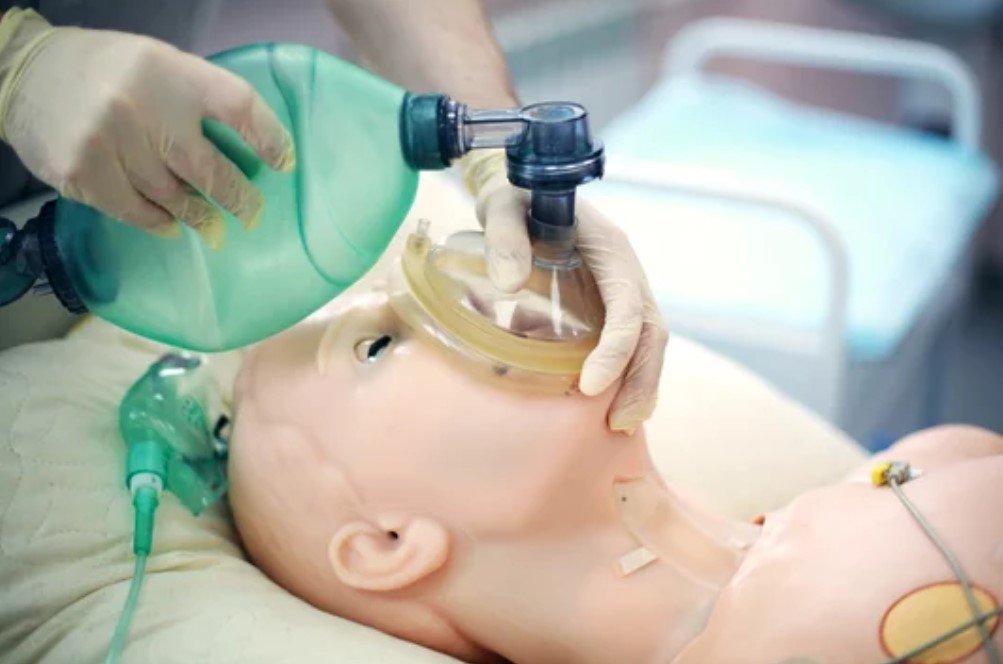
- What advantages does using an Ambu bag for artificial respiration offer over manual methods?
- Under what circumstances should CPR (the combination of chest compressions and artificial respiration) be administered instead of artificial respiration alone?
- For how long should a first responder continue to perform artificial respiration or CPR on a victim?
- Explain the proper hand placement and compression depth for performing chest compressions on an adult.
——————————————————————————–
Answer Key
- The fundamental purpose of artificial respiration is to provide external respiratory support to an individual whose breathing has stopped or is insufficient. Its primary goal is to supply oxygen to the lungs, ensuring that vital organs, especially the brain, do not suffer permanent damage from oxygen deprivation. This procedure is a critical component of basic life support.
- Situations that may require artificial respiration include drowning, where water fills the lungs; heart attack or cardiac arrest, which can stop breathing; and high-current electric shock, which can disrupt the heart’s rhythm and the respiratory center. Other causes include poisoning (e.g., carbon monoxide), severe head trauma, and anaphylaxis.
- The “Look-Listen-Feel” method is a technique used to check for breathing after opening a victim’s airway. The first aider places their ear near the victim’s mouth and nose for 10 seconds to look for chest movement, listen for breath sounds, and feel for the warmth of exhaled air on their cheek. It is performed to determine if artificial respiration is necessary.
- “Mouth-to-mouth” is the most common method, where the rescuer blows air directly into the victim’s mouth while pinching the nose shut. “Mouth-to-nose” is an alternative used when the mouth is severely injured or cannot be opened; in this method, the rescuer closes the victim’s mouth and blows air into their nostrils.
- The standard, integrated CPR approach for an adult involves a continuous cycle of 30 chest compressions followed by 2 rescue breaths (artificial respiration). This 30:2 ratio is consistently applied to provide both circulation and oxygenation.
- When opening an infant’s airway, the head should only be tilted back gently into the “sniffing position,” as if they are smelling the air. Overextending an infant’s neck can close off their delicate airway. In contrast, an adult’s head is tilted back more firmly by pushing on the forehead and lifting the chin.
- An Ambu bag, used primarily by healthcare professionals, is a more effective and hygienic method of ventilation. It can deliver a higher volume of oxygen than mouth-to-mouth and eliminates direct contact between the rescuer and the patient, reducing the risk of disease transmission.
- CPR should be administered when a person has no pulse in addition to not breathing. If the victim is not breathing but still has a pulse, only artificial respiration (rescue breaths) should be performed. The combination is necessary when both cardiac and respiratory functions have ceased.
- A first responder should continue performing artificial respiration or CPR without interruption until one of three things occurs. The intervention should continue until professional medical help (such as an ambulance crew) arrives and takes over, the victim begins to show signs of normal breathing and circulation, or the rescuer becomes too exhausted to continue safely.
- For adult chest compressions, the heel of one hand is placed on the lower half of the sternum (breastbone), between the nipples, with the other hand interlocked on top. The rescuer should keep their arms straight and use their body weight to compress the chest to a depth of 5-6 cm at a rate of 100-120 compressions per minute.