
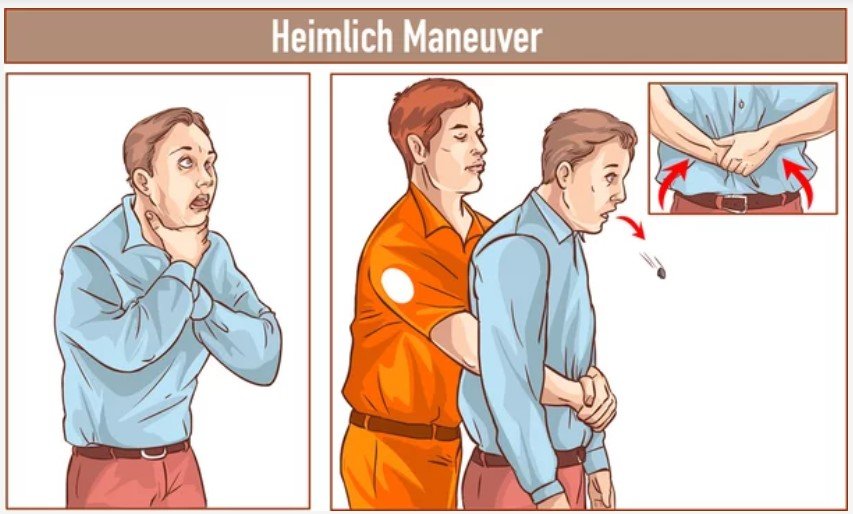
Imagine a lively dinner with friends. Laughter fills the room until, suddenly, one person falls silent. Their hands fly to their throat, their eyes wide with panic. They’re choking. In this critical moment, many people would rush to perform the Heimlich maneuver. But this well-known technique is often misunderstood.
Knowing the correct way to respond can be the difference between a panicked reaction and a life-saving action. This article reveals four of the most surprising and critical details about the Heimlich maneuver that everyone should know to act correctly and confidently in an emergency.
- The Most Important First Step Is Often… to Do Nothing.
This may sound counter-intuitive, but intervening too soon can make things worse. If a person who is choking can still cough forcefully, speak, or cry, your first and most important action is to encourage them to keep coughing.
Coughing is the body’s most effective and natural defense for dislodging a foreign object. You should only intervene with abdominal thrusts when the person’s own efforts are failing. The specific signs that indicate it is time to perform the Heimlich maneuver are:
- The person cannot speak, cry, or laugh.
- Their coughing is weak or silent.
- They are having obvious difficulty breathing.
- You notice a change in the color of their skin, lips, or nails.
- The Maneuver Is Not a One-Size-Fits-All Solution
The standard Heimlich maneuver is designed for conscious adults and children over one year of age. Applying it incorrectly or to the wrong person can be ineffective and potentially harmful. There are crucial exceptions for specific situations.
- For Babies (Under 1 Year Old): The standard maneuver is not recommended for infants. The correct procedure involves a combination of back blows and chest thrusts. First, lay the infant face down on your forearm, ensuring their head is positioned lower than their body. Using the heel of your hand, deliver five firm back blows between their shoulder blades. The blows should be strong but not injurious. After the back blows, check the infant’s mouth and remove any visible objects. If the airway is still blocked, turn the infant over and perform chest thrusts.
- For Pregnant Individuals: The standard abdominal thrusts could harm the fetus. For a pregnant person, the maneuver must be modified. Instead of placing your hands on the abdomen, pressure should be applied higher up, on the breastbone (sternum).
- You Can Be Your Own Hero: How to Perform It on Yourself
The possibility of choking while alone is a frightening thought, but knowing how to respond can be empowering and life-saving. You can perform the Heimlich maneuver on yourself using one of two methods.
- Method 1 (Using Your Hands): Make a fist and place it on your abdomen, above your navel and below your rib cage. Grasp your fist with your other hand and thrust sharply inward and upward. Repeat this motion until the foreign object comes out and you can breathe and cough.
- Method 2 (Using Furniture): If you are unable to generate enough force with your hands, lean over a hard, stable object. The back of a chair, a countertop, or a table corner can be used. Press your abdomen sharply against the edge of the object to create a strong upward thrust.
- Precision Matters: Where and How to Thrust
The effectiveness of the Heimlich maneuver depends entirely on precise hand placement and the correct motion. Performing it incorrectly will not generate the force needed to clear the airway. The goal is to put pressure on the diaphragm, using the air in the person’s lungs to force the object out.
Here is the exact procedure for performing the maneuver on another person:
- Positioning: Stand behind the person and wrap your arms around their waist. It is important to lean them forward so their upper body is roughly parallel to the ground. This position uses gravity to help dislodge the object and prevents it from falling back into the airway if cleared.
- Hand Placement: Make a fist with one hand. Place the thumb side of your fist on the person’s abdomen, in the specific spot between the navel and the bottom of their rib cage. Grasp your fist firmly with your other hand.
- The Motion: Perform a series of 5 strong thrusts. The motion must be directed both inward and upward, as if you are trying to lift the person up.
After each series of five thrusts, check if the object has been expelled. Continue performing sets of five thrusts until the object is dislodged and the person can breathe, cough, or speak again.
Conclusion: Prepared for the Unexpected
A choking emergency can happen anywhere, at any time. Understanding these critical details—the importance of assessing before acting, knowing the exceptions for babies and pregnant women, the ability to perform the maneuver on yourself, and the precise technique required—is essential.
Knowing these details transforms a panicked reaction into a confident response—are you prepared to be the person who knows exactly what to do?